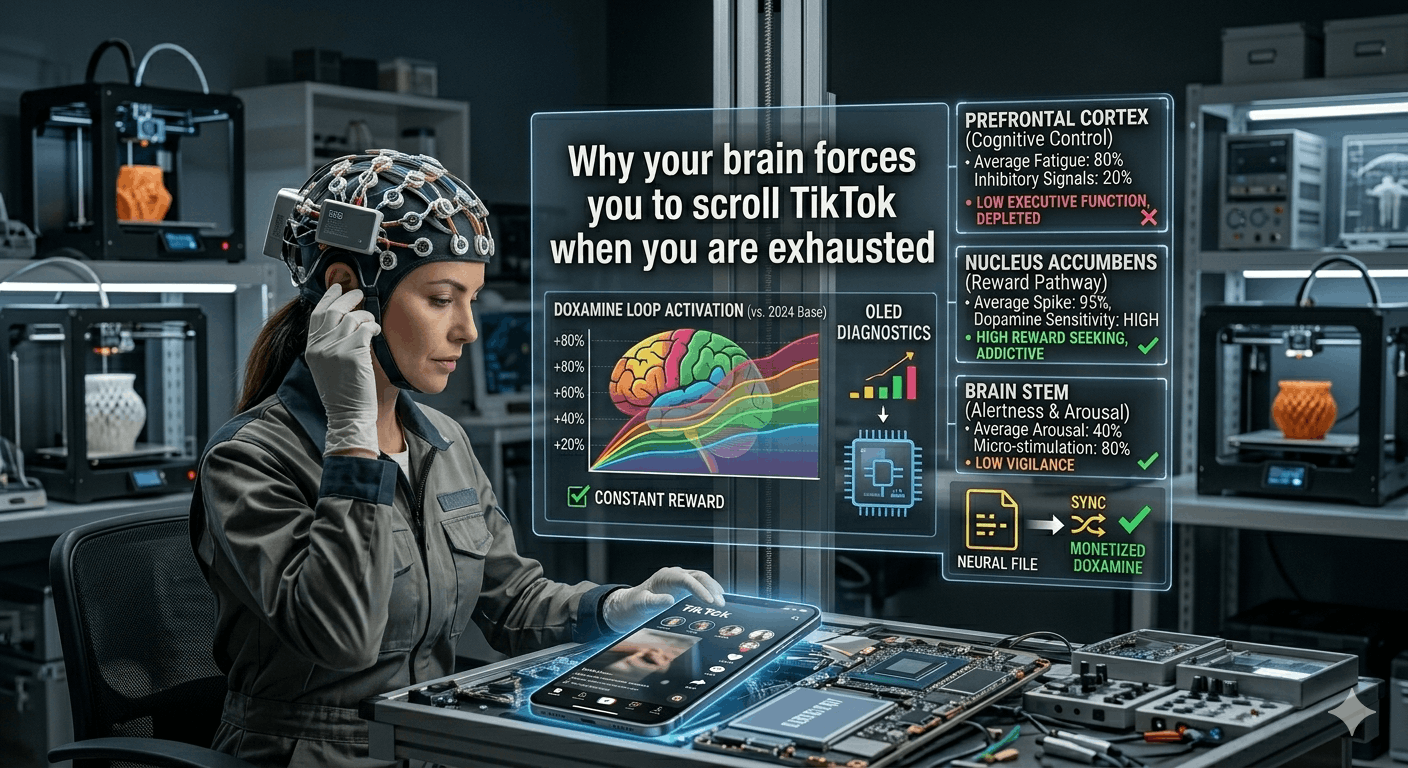
You are completely drained. Your eyes are burning, your lower back aches from a brutal day at your desk, and your bed sheets are calling your name, yet you find yourself sitting on the edge of the mattress, frozen in place for forty-five minutes straight, endlessly flicking your thumb upward against a glowing glass screen. It feels entirely automatic.
Your willpower hasn’t collapsed.
Truth be told, your brain is actively tricking you. When fatigue hits its peak late at night, the advanced neural circuits that handle your rational decision-making processes are the very first systems to shut down, leaving your primitive survival drive to steer the ship. You aren’t scrolling because you have plenty of energy; you are scrolling precisely because your cognitive battery is completely dead.
Expert Insight: The Energy Paradox Putting your phone down and closing your eyes actually requires an active injection of mental energy called executive control. When you are thoroughly exhausted, your brain chooses the option that requires the absolute lowest amount of friction—which means riding the automated wave of a pre-loaded video feed.
The Chemistry of Bedtime Procrastination: The Prefrontal Cortex Offline
Let’s look at the underlying neurobiology of your tired mind.
The front section of your skull houses the prefrontal cortex, a highly sophisticated command center responsible for long-term planning, impulse control, and forcing you to do the responsible things that make your life better. Think of this region like a high-performance laptop battery that slowly drains every single time you make a decision, resist a temptation, or solve a problem during your workday.
By 11:00 PM, that battery is sitting at one percent.
Shutterstock
Your brain essentially experiences a state of mild, temporary frontal lobe impairment every single night. When this executive control network goes dark, you completely lose the cognitive strength required to tell yourself, “This video isn’t worth it; I need to rest for my early meeting tomorrow.”
The Dopamine Minimum Wage
Your tired brain is desperate for a chemical lifeline.
When you are deeply fatigued, your system experiences a sharp drop in baseline neurochemicals, creating a state of internal discomfort that your subconscious mind wants to fix immediately. It searches for a rapid, low-effort hit of dopamine to bring its chemistry back up to a comfortable survival level.
It wants a quick win.
TikTok functions as the ultimate digital currency exchange for a bankrupt mind. The app doesn’t ask you to read a complex article, analyze a plot point, or solve an interactive puzzle; it simply asks you to stare blankly into the light while it feeds your sensory system a highly concentrated stream of visual and auditory micro-rewards every nine seconds.
The Micro-Reward Mechanism: TikTok’s Slot Machine for Fatigue
The app operates exactly like an architectural slot machine tailored for a tired mind.
When you pull the lever on a casino game, you don’t win every single time. It is the unpredictable nature of the reward—the fact that a massive jackpot could drop on the next spin—that forces your brain to lock onto the mechanism with addictive intensity.
TikTok’s For You Page utilizes this precise psychological trick.
[Swipe Up] ➔ [Boring Video: No Reward] ➔ [Swipe Up] ➔ [Hilarious Video: Dopamine Spike!] ➔ [Loop Restarts]
One video is a dull cooking tutorial, the next is a political shouting match, but the third one is a perfectly targeted piece of comedy that makes you laugh out loud in your dark room. That sudden, unexpected surge of neurochemical satisfaction instantly burns a path through your exhausted neural pathways.
You keep swiping because you are hunting for the next spike.
The Path of Least Resistance
Why do I doomscroll when I’m tired?
Let’s look at the actual energy exchange happening in your muscles. Closing an app, plugging in your charger, turning off the bedside lamp, and adjusting your pillows to sink into sleep requires you to initiate a series of physical movements.
Swiping your thumb upward takes less than half a calorie of effort.
+----------------------------------------+----------------------------------------+
| Cognitive Drag of Sleep Prep          | Low-Friction Digital Drift            |
+----------------------------------------+----------------------------------------+
| Moving your body to set an morning     | Staying perfectly still under a heavy  |
| alarm and clear your workspace.        | comforter while your eyes glaze over.  |
+----------------------------------------+----------------------------------------+
| Navigating the anxious thoughts of     | Outsourcing your internal internal     |
| tomorrow's high-stakes assignments.   | narrative to a stranger's background.  |
+----------------------------------------+----------------------------------------+
Your system always picks the lowest energy investment when it’s running on empty. By remaining frozen on your side, you drop into a state of passive digital drift where the algorithm does all the cognitive processing for you, serving up pre-digested media bites so your tired brain doesn’t have to think.
Revenge Bedtime Procrastination and the Fight for Autonomy
Your schedule is stealing your life, and your night-scrolling is a desperate rebellion against that theft.
When you spend your entire day answering to demanding supervisors, managing family crises, and fulfilling strict social obligations, your psyche feels completely stripped of its personal autonomy. You look back at your day and realize you didn’t have a single hour that belonged exclusively to you.
The night becomes your final battleground.
How do I stop scrolling TikTok before bed? You have to understand that your brain is staging an emotional protest called revenge bedtime procrastination, deliberately sacrificing its own cellular physical recovery just to claw back a temporary sense of personal freedom.
The Illusion of Stress Relief
You tell yourself you are just winding down.
It feels like a relaxing reward after a brutal shift, a harmless way to decompress your nervous system before drifting off to sleep. Sadly, your internal biology does not view this constant stream of short-form video as a calming lullaby.
The screen is a neurological lightning storm.
What does TikTok do to an exhausted brain? While your body sits perfectly still underneath the sheets, your brain waves are frantically spiking as they process a non-stop barrage of neon text overlays, sudden audio jump cuts, and shifting visual perspectives every seven seconds.
Your mind is running a marathon while your heart rate drops.
Expert Insight: The Cortisol Spike The human brain evolved to associate sudden visual changes with physical danger. When you blast your optic nerve with rapid-fire video cuts in a pitch-black room, your adrenal system releases micro-bursts of cortisol to keep you alert, leaving you in a state of wired exhaustion where you are too tired to function but too chemically stimulated to sleep.
Shifting From Cognitive Control to Automated Muscle Memory
The transition happens completely without your conscious permission.
During the first ten minutes of your evening scroll, you are making intentional choices about which creators to watch or swipe away. As the clock ticks past midnight, your conscious mind enters a state of deep hypnotic trace, transferring complete control of your hands directly to your automated subcortical habit loops.
Your thumb takes over completely.
[Optic Nerve Flooded with Light] ➔ [Melatonin Production Frozen] ➔ [Circadian Rhythm Fractured]
You are no longer actively deciding to view the content. You have entered a state of pure motor-sensory automatism, performing the physical gesture of swiping over and over again like a robot, while your higher-level thinking circuits remain entirely detached from the reality of the passing hours.
The Blue Light Optical Illusion
Your phone is forging a massive biological lie.
Deep inside your eyes, specialized photoreceptor cells track the presence of high-intensity short-wavelength blue light to determine the exact time of day. In nature, this specific light spectrum is only found during peak afternoon sunshine hours, signaling your pineal gland to stop producing melatonin completely so you can stay sharp and hunt for resources.
Your phone replicates high noon in the middle of the night.
By staring directly into that bright display, you are effectively shouting at your circadian clock that the sun is still blazing overhead. Your body can be desperately craving cellular repair, your muscles can be saturated with metabolic waste products, but as long as that blue light keeps hitting your retina, the chemical signal to initiate deep sleep will never be released into your bloodstream.
Breaking the Circuit: Tactical Safeguards for a Fading Prefrontal Cortex
You cannot rely on your late-night willpower.
We must accept the hard reality that your tired brain is completely outmatched by a multi-billion-dollar algorithm engineered by the world’s smartest data scientists to capture your attention. If you wait until you are exhausted to try and make a good decision, you will lose the battle every single time.
You have to build structural speedbumps ahead of time.
The secret is to outsource your discipline to your physical environment before your internal battery drops into the red zone. By adding physical and digital friction to your evening routine, you stop the automated habit loop from triggering in the first place.
Expert Insight: The Out-of-Reach Rule Move your phone charger completely across the room, away from your nightstand, or plug it into an outlet inside your bathroom before you even brush your teeth. Forcing your body to physically stand up, step out of the warm covers, and walk across cold flooring to check a notification creates an immediate blast of physical friction that instantly wakes up your prefrontal cortex.
You have to change the default settings of your digital environment.
Go into your device parameters right now and turn on the native grayscale accessibility mode. Stripping away the vibrant, flashing neon colors of the video thumbnails completely ruins the visual slot machine effect, turning a highly stimulating dopamine loop into a dull, flat, and boring gray landscape that your tired brain will naturally want to turn off after two minutes.
[Isolate Phone Charger] ➔ [Trigger Greyscale Mode] ➔ [Break Automated Habit Loop]
Let’s look at the absolute truth here at the end of the day. Your compulsive midnight scrolling isn’t a character flaw or a sign of personal weakness; it is a predictable, biological consequence of a highly exhausted nervous system searching for an easy chemical escape from the brutal pressures of your daily routine.
Stop letting a corporate data loop rob you of your physical health, your deep cellular recovery, and your morning energy reserves. Take a stand for your autonomy before you get under the covers tonight, lock down your physical devices, and give your mind the quiet, dark, and uninterrupted rest it has actively earned.
To review the latest psychological frameworks on how behavioral friction can successfully break deeply ingrained habit loops, check out the cognitive research index hosted by the American Psychological Association.