The loudest person in the room is almost always the weakest.
You see them all the time at business dinners and corporate meetups, frantically filling every pocket of silence with hyperactive laughter, boasting about their latest wins, and desperately trying to manipulate the crowd into giving them a shred of validation. Everyone sees right through it.
Real status operates in complete silence.
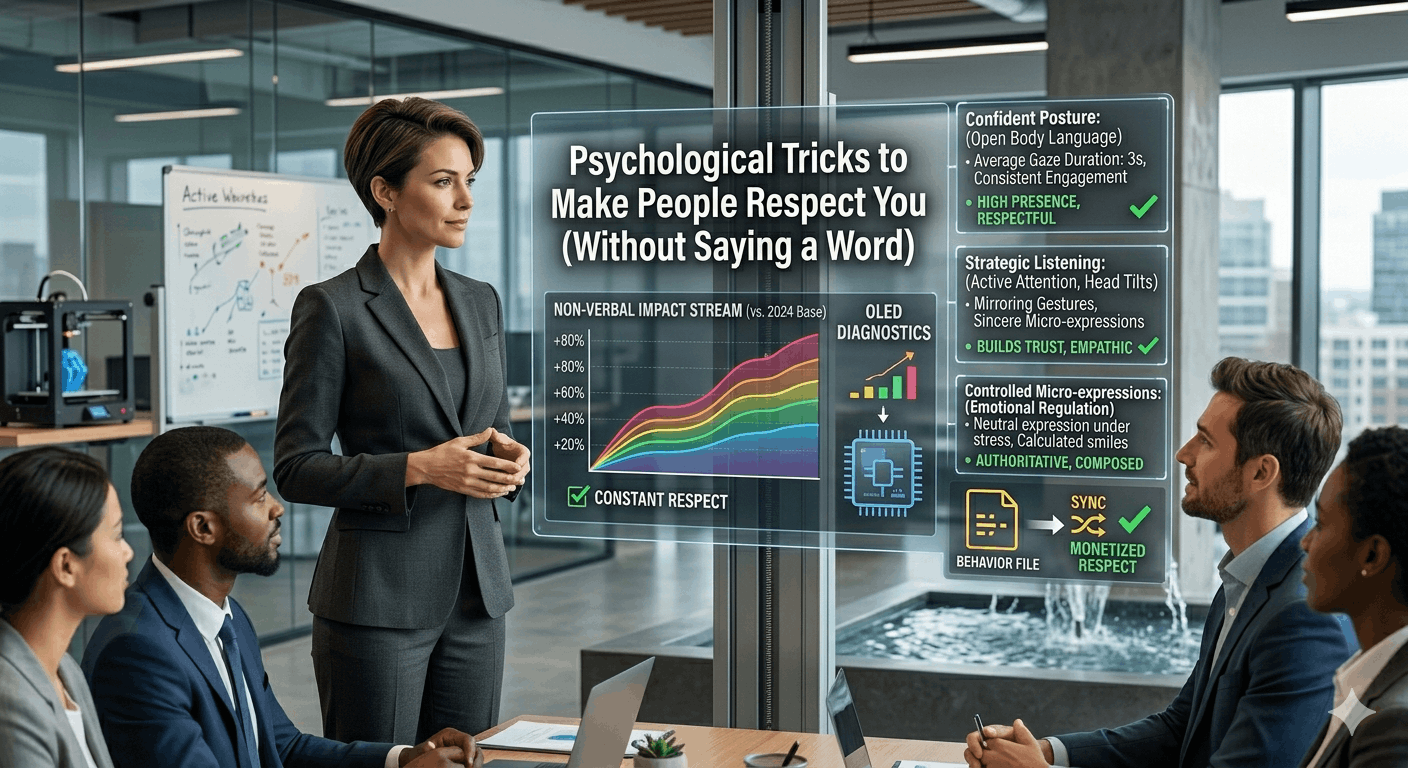
Truth be told, human beings are intensely evolutionary creatures who constantly scan their social environment for nonverbal dominance signals, calculating your social value long before you ever have a chance to open your mouth and deliver a spoken introduction. If your body language is unconsciously broadcasting insecurity, the most brilliant script in the world cannot save you. You have to train your physical presence to command respect automatically.
Expert Insight: The Pre-Speech Audit Your nervous system constantly leaks information through micro-gestures. Low-status individuals prioritize comfort and safety, which manifests as protective, closed body language. High-status individuals prioritize spatial awareness and calm stillness, signaling to the room that they view themselves as the apex entity in that specific environment.
The Micro-Expression Framework: Controlling the First Four Seconds
First impressions are decided at a subcortical level.
When you enter a room or sit down at a high-stakes negotiation table, the people already present will run an automated social assessment on you within four seconds flat. They aren’t looking at your outfit or checking your credentials.
They are looking at your neck and your eyes.
Low-status individuals display an instinctive, rapid head tilt or a quick jerk of the chin when a new person approaches, a subconscious survival response designed to protect the vulnerable jugular vein from a sudden physical predator. It screams anxiety.
The Unblinking Pivot
You must master the art of the slow turn.
Instead of snapping your gaze toward a sudden noise or moving your head instantly when a colleague speaks to you from across the room, you must introduce a deliberate, rhythmic delay into your physical anatomy.
Move your eyes first, then let your head follow at a glacial, unbothered pace.
[External Stimulus/Voice] ➔ [1-Second Delay] ➔ [Eyes Lock Target] ➔ [Head Slow-Pivots]
This specific, measured cadence forces the other person to wait a brief millisecond for your complete attention, instantly signaling to their subconscious brain that your internal focus is incredibly valuable and cannot be easily shaken by outside disruptions.
Weaponizing Spatial Dominance Without Aggression
Space is the ultimate nonverbal currency.
Look, honestly, between you and me, most people are profoundly terrified of taking up physical room because they don’t want to be perceived as a threat or draw negative attention to themselves in a group dynamic. They fold inward.
They cross their ankles tightly under their chairs.
They hug their folders against their chests like a plastic shield, compress their elbows flush against their ribs, and curl their shoulders forward to minimize their physical silhouette as much as possible. It looks like a defensive crouch.
The Open-Frame Architecture
You need to open up your physical blueprint.
High-status individuals utilize what behavioral psychologists call open-frame architecture, meaning they naturally rest their limbs in expansive, unhurried configurations that expose their vital organs to the room. They aren’t trying to act tough or aggressively puff out their chests.
They are simply comfortable with vulnerability.
How can I look more powerful and confident without talking? You begin by anchoring your elbows completely outside the armrests of your chair, spreading your personal items intentionally across the meeting table, and allowing your knees to set at a natural, shoulder-width distance.
+------------------------------------+------------------------------------+
| Low-Status Defensive Reflexes       | High-Status Silent Anchoring       |
+------------------------------------+------------------------------------+
| Constantly adjusting clothing,     | Total physical stillness, keeping  |
| touching the neck, or fidgeting.   | hands visible and relaxed.         |
+------------------------------------+------------------------------------+
| Snapping attention instantly to    | Utilizing a calculated delay       |
| whoever speaks first in a group.   | before turning to face speakers.   |
+------------------------------------+------------------------------------+
| Shrinking personal items into a    | Spreading notebooks and devices to |
| tight, neat pile close to the body. | claim physical table territory.    |
+------------------------------------+------------------------------------+
Look at the stark behavioral divide in that matrix. The defensive actor is constantly bleeding energy through micro-fidgets, while the silent anchor uses physical calmness to broadcast a deep message to everyone in the room: I am completely safe, and I own this square footage.
Expert Insight: The Fidget Tax Every single time you touch your phone, twist your ring, click a pen, or fix your collar during a meeting, you are paying a silent “status tax” to the room. The human brain instantly identifies these repetitive movements as nervous displacements used to burn off excess adrenaline. True authority is rooted in absolute physical stillness.
The Power of the High-Status Pause
Time bends to the person who refuses to rush.
When an amateur is asked a difficult question during a high-stakes corporate presentation, their immediate, anxious instinct is to blurt out an instant response to fill the dead air and prove they know their stuff. They stumble over their first few words.
They sound desperate for approval.
How do you psychologically force people to respect you? You weaponize the silence by leaning backward into a long, calculated conversational pause before giving any indication that you even heard the prompt.
Quick Reality Check
- The Myth: Fast, rapid-fire responses show that you are sharp, highly intelligent, and completely in control of the business data.
- The Fact: True power players purposefully delay their reactions, forcing the room to wait on their terms and proving that they cannot be pressured into a sloppy, uncalculated answer.
The room will instantly freeze.
When you refuse to rush your reaction, the psychological tension flips completely onto the person who asked the question, making them wonder if they said something foolish or out of turn. You control the room’s clock without saying a word.
Most networking books give you terrible advice.
They tell you to constantly mirror the body language of the person you are talking to, suggesting that if they lean in, you should lean in, and if they cross their legs, you should do the same to build instant rapport. That is a massive trap.
If you mirror someone blindly, you are letting them set the emotional wavelength of the interaction.
True psychological power belongs to the person who remains completely unswayed by the emotional energy of others. When someone bursts into your workspace with high-energy panic, loud complaints, or aggressive posturing, your job is to act like a stone wall that absorbs their frantic waves without vibrating in return.
[Chaotic/Aggressive Energy] ➔ [Your Unbroken Neutrality] ➔ [Their Energy Plummets to Match Yours]
What are silent body language tricks that command respect? You maintain a completely relaxed, deadpan facial expression for the first three seconds of their outburst.
Do not nod. Do not smile politely to soothe their anxiety.
By refusing to automatically sync up with their chaotic rhythm, you silently communicate that their emotional storm is far too small to disrupt your internal equilibrium. Within moments, you will watch their shoulders drop and their voice de-escalate as their subconscious brain naturally lowers its frequency to match your unshakeable baseline.
Expert Insight: The Blink Rate Sabotage Under intense social pressure, an anxious brain will spike its blink rate up to fifty or sixty blinks per minute as it searches for exits. High-status operators consciously train themselves to keep their blink rate extremely low and steady—around twelve to fifteen blinks per minute—projecting the terrifying, calm focus of an apex predator.
The Emotional Anchor State
You must become the psychological anchor of the environment.
Think about a time you watched a true master of an industry navigate a corporate crisis. They didn’t run around waving their hands or matching the frantic pacing of the room; they sat perfectly still in the middle of the storm, tracking the room with steady, deliberate movements.
They let everyone else burn through their nervous energy first.
When you maintain this absolute neutral state, you subtly force the people around you to start filtering their behavior through your approval. They will begin checking your face for micro-expressions to see if they have crossed a line, effectively handing you full psychological control of the room without you having to utter a single syllable of direction.
Environmental Manipulation: Setting the Physical Terms of Engagement
Your physical environment is not fixed; it is a canvas for your personal authority.
When you enter a shared workspace, an executive boardroom, or a casual restaurant for a networking lunch, you must consciously choose how you interface with the architectural layout of that room. Low-status individuals passively accept whatever seating arrangement or physical placement is handed to them, often tucking themselves away into cramped corners or facing highly disruptive traffic pathways.
They let the room dictate their comfort.
You must do the exact opposite by subtly manipulating the physical geometry of your workspace to anchor your personal focus.
[Arrive at Space] ➔ [Isolate High-Value Seating] ➔ [Expose Eyes to Room Threshold]
If you are choosing a chair at a conference table, always aim for the position that gives your eyes a clear, unobstructed view of the main entry threshold while keeping your back completely protected by a solid wall.
It is a primal, subconscious positioning trick.
When you sit facing the door with a secure barrier behind you, your primitive survival brain instantly drops its guard because it doesn’t have to waste valuable subconscious processing power monitoring potential blind spots or unexpected threats. You will radiate an unmistakable aura of profound relaxation and absolute environmental control that everyone in the room will instantly sense and respect.
Expert Insight: The Prop-Space Expansion Never allow your personal belongings—like your smartphone, leather portfolio, or coffee mug—to be compressed into a tiny, apologetic pile right in front of your chest. Spread your tools outward to deliberately map out and claim your physical territory on the table surface, forcing others to visually acknowledge and respect your expanded operational boundary.
Take a look around your social and professional circles tomorrow morning with fresh, analytical eyes.
Stop believing the old corporate lie that you have to be the loudest, most aggressive talker in the department to climb the organizational ladder or command the attention of high-level stakeholders. Real, unshakeable respect is never demanded through loud verbal declarations; it is quietly pulled from the environment through flawless physical discipline, calculated stillness, and absolute emotional stability.
Lock down your micro-expressions tonight, take up your rightful physical space at the next group gathering, and watch how quickly the entire room naturally adjusts its behavior to earn your silent approval.
To explore the advanced behavioral science behind how environmental layout and spatial architecture alter human social status dynamics, review the comprehensive peer-reviewed research compiled by the American Psychological Association behavioral archives.